 TV
TV
Front Window
With opportunism, little scruple and a recipe that has drawn TV audiences around the world, SBT (Sistema Brasileiro
de Televisão—Brazilian System of Television) has consistently beaten Globo—a TV network that with opportunism and
little scruple has maintained a far-ahead first place for decades—in the Brazilian TV's audience war. The answer to the
almost uncontested Globo's leadership is Casa dos
Artistas (Artists' Home), a term that until now meant a retirement home for
older artists who in their old age were having serious financial problems.
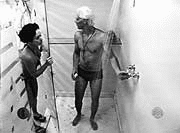
Casa dos Artistas is based on "Big Brother," a creation from the Dutch TV. Aired originally in Holland in 1999 the idea was sold to 33 countries. In Britain, "Big Brother" was a hit in the summer of 2000. The show with a group of unknowns locked inside a house without any contact with the outside world was the talk of the country, and its final episode was seen by 10 million people. In the US the idea was less successful. CBS paid $20 million and used 28 cameras (including in the bathroom) and 60 microphones to capture for three months the life of 10 people confined in a wired house built in San Fernando Valley, in Greater Los Angeles. They all had to fit in two bedrooms. Every two weeks two people were eliminated by votes from their peers and the TV audience, the last one got a reward of half a million dollars. The show that started with a 27 share (almost one third of all TV sets turned on that night) in the Nielsen ratings soon fell to a 10 share (less than 10% of the TV viewers.
 Silvio Santos, a folkloric figure and former street vendor who owns and controls SBC as a small town coffee shop,
enjoyed all the success without paying a dime to the Dutch and chose for housemates a group of semi-celebrities of Brazilian TV,
fashion and music world. The detention would last 50 days. The prize for the last survivor: around $100 thousand. The airing of
the program was maintained a secret until Sunday, October 28, when SBT started to air promos of the show.
Silvio Santos, a folkloric figure and former street vendor who owns and controls SBC as a small town coffee shop,
enjoyed all the success without paying a dime to the Dutch and chose for housemates a group of semi-celebrities of Brazilian TV,
fashion and music world. The detention would last 50 days. The prize for the last survivor: around $100 thousand. The airing of
the program was maintained a secret until Sunday, October 28, when SBT started to air promos of the show.
The show became a fever, with 20 million people watching it daily. Veja (1.3 million copies), Brazil's most influential weekly newsmagazine, dedicated a cover to the program. The 9-pm spectacle went to peaks of 43 points in the Ibope, the Brazilian Nielsen. Globo, which for 28 years has led the Sunday with the prime-time program Fantástico, ran for cover while rocker Supla one of the guest in the Casa dos Artistas sang with his 11 companions of captivity:
Mais um dia aqui
sem poder sair
dentro desta prisão
Silvio Santos vem aí
com muito Ibope ele vai sorrir
Another day here
Not being allowed to leave
Inside this prison
Silvio Santos is coming
With lots of Ibope he'll smile
Globo went to court to prevent the program from being aired. After all, it had a good reason for that: the giant
network—the 4th biggest in the world, just after the American three sisters—had bought, in August, the rights to exhibit the show
in Brazil. The show is scheduled for March 2002.
For some time, the Rio network seemed to have the upper hand. A judge accepted the argument of Globo that Casa dos Artistas was a breach of copyright and ordered SBT to stop airing the show. The measure, though, was annulled by another judge, and the show went on.
Thomas Notermas, spokesman for Endemol, the Dutch company that created Big Brother, says that he deals with piracy of their shows all the time, but nothing has ever come close to SBT's plagiarism: "This is the most scandalous infraction I've ever seen."
Luis Erlangeer, director of Central Globo de Comunicação, called the SBT action an act of piracy: "This must seem like just another skirmish to the audience, but it's something much more serious. It's a question of knowing if intellectual property is something that will be respected in Brazil."
The fancy living room was the favorite place for the participants to show off most of the time in skimpy clothes. Silvio Santos used a neighbor's house, in the Morumbi neighborhood in which he lives, to be adapted to serve as the stage for his show. The participants had to make do with two bedrooms, one bathroom and a kitchen.
Differently from the European model, SBT chose people well known from the Brazilian public. People like models Alessandra Iscatena, Mari Alexandre, Núbia Ólive and Nana Gouveia, actress Bárbara Paz, singer Patrícia Coelho, singers Supla (rocker and son of São Paulo's mayor Marta Suplicy) and Leandro Lehart, plus actors Alexandre Frota, Matheus Carrieri, Taiguara Nazareth and Marcos Mastronelli. Two of the girls showed it all in Playboy, two of the boys also appeared naked in magazines.
Forty microphones and 33 cameras were installed, most of them behind mirrors in a way that the cameramen could not be seen by the artists. More than a simple dispute the war between the number one and far-behind number two showed the degree of distrust and the bad blood between the two competitors.
In its official announcement Globo accused Santos's network of piracy reclaiming higher moral ground. "The Brazilian entertainment industry can only grow if it's based on respect for the law and moral principles." To which SBT replied also in an official note: "The Brazilian entertainment industry can only grow if TV Globo will let it."
Globo's official note:
"A country that does not respect the intellectual right will never be developed. The Brazilian entertainment industry can only grow if it's based on respect for the law and moral principles.
Frequently our images are used without authorization—disrespecting and preventing artists and technicians to receive credit for their work. Once again we are victims of piracy: SBT presents a show that's nothing more than a sensationalist plagiarism of Big Brother, a world famous attraction, whose rights were acquired by us in August, as is common knowledge.
Our indignation is even bigger because at the time that the Brazilian society yearns for ethics, this type of behavior is an example of disregard for one of the most elementary values—the one that one's rights end where another's rights begin. We have no other remedy but to appeal to the Justice, which, we should mention, has just voted in our favor in another action against the same TV, which was fined and forbidden to air a plagiarism of our program Gente Inocente (Innocent People)."
Central Globo de Comunicação.
SBT's official response:
"The Brazilian entertainment industry can only grow if TV Globo will let it. Globo Network commemorates the first defeat of its show Fantástico threatening to sue SBT for plagiarism of a program not shown. Not satisfied with defeating Globo TV's audience index all through Sunday, SBT had the imprudence of, for the first time defeat the Fantástico, without asking for the due forgiveness to this pillar of morality and correction that is Globo TV.
In truth SBT, Sunday, SBT lost only to Corinthians (popular soccer team), one of the hired hands of Globo, which was not playing as expected, but ended up playing a great match. To top it all, Saturday, battling against SBT's novela, the Jornal Nacional (prime-time new program) hit a new mark in its downhill trajectory, going down to 31 percent, a new experience. All of this without mentioning Xuxa, Faustão and other innocent people, all of them deserving of our esteem and respect, but who are routinely defeated on Sunday afternoons.
For all of this it is fair that Globo sue us, even though it is for plagiarism of a program that hasn't even been produced. It will be plagiarism by guess, by premonition.
Globo is right when it says it is a victim of SBT and its illegal practices.
After all, due to the fierce, immoral and illegal persecution of which it is a victim, Globo TV has been reduced to a mere National TV Network, plus a National Radio Network, plus half a dozen newspapers that haven't allowed it yet to eliminate the competition, including a new newspaper in São Paulo that, as we all know, didn't have a newspaper with the high ethical and moral principles of the current Diário de São Paulo.
Not to talk about the companies and entrepreneurs affiliated with the company, each one less powerful than the other, not having, as a rule, more than the leading newspaper in each state.
This is so true that they only own a sole company of Television by Satellite, distributing mere 60 channels, and a few other cable TVs with the same number of channels.
Also in the editorial area, Globo has not surpassed a couple of dozen titles and it wasn't able either, until today, to eliminate other recording companies with its Som Livre. Let make if brief: so much is the persecution moved against the company by the insatiable SBT that Globo was able to secure exclusivity only for the whole Brazilian football and the next two World Cups. All of this without places to present their ads, without resources for a more aggressive marketing, causing them enormous losses and offering gifts for those who subscribe to their titles, modest that's true, only TV sets or plane tickets to any place in Brazil.
Globo is right when it says in its note that "the Brazilian entertainment industry can only grow if it's based (sic) on the respect for the law and moral principles" and that "society yearns for ethics."
This is true. As we know, it is highly moral and ethical to pay fines and assume the judicial cases of author under contract, so that SBT cannot use a sole writer; it is extremely ethical to buy events to not show them; to suborn people under contract only to mess up the competition; as we know, it's extremely ethical to sell newspaper at the cost of desperate parents and kidnapped daughter (a reference to the covering Globo gave to the kidnapping of Silvio Santos's young daughter earlier this year even though the tycoon had asked media outlets to not divulge news while negotiations were going on for the release of the youngster). All of this is highly commendable, it is exemplary."
SBT, while Globo is not the sole medium, the sole employer, is not the sole Power, the Big Brother who yearns to be the owner of the TV who will keep us under surveillance, until this day SBT will continue working and defeating, without luxury and with modesty, defeating the Power, the Wealth and the Prepotency, today disguised as moralists.
SBT's management
Book
My Belle Spy
One hundred and thirty-seven years ago, the Countess Isabelle Sophia Bario, diplomatic representative of Emperor
Dom Pedro II of Brazil, sailed to war-ravaged America, to negotiate with President Lincoln to allow Brazil to trade with the
Confederate States of America. In fact, she was a rebel spy and instead of treaties, Sophia was after Union secrets. What
she found instead was intrigue and murder. Fleeing for her life, Sophia was rescued by Captain Robert Norton, a
Confederate cavalry officer. Thus began a torrid love affair with strategic implications.
Countess Bario's story comes from Marietta author Derek Hart.
For Love or Honor Bound is a Civil War historical
romance novel based in large part on the author's ancestors, who fought on both sides during the conflict. "My relatives were
from South Carolina and Pennsylvania," stated Mr. Hart. "The attic was rich with letters and diaries—tales of valor and
sacrifice for causes each believed in."
Derek Hart has been writing fiction and studying military history for over 26 years now, but the War Between the States
has always been close to his heart. "Ever since childhood I was intrigued with the Civil War," the author said, "but when
you discover your ancestors actually fought in it, well that makes it personal and real. I write fiction, so it was just natural to
spin tales about the Nortons and Oetzels and how the Civil War changed their lives."
Taking the genealogical research seriously, Mr. Hart delved into state and county records, read scores of Confederate
and Union regimental histories, and even employed a Brazilian friend to help translate Portuguese and advise on Brazilian
customs. "The book is fiction, but I made every attempt to blend fact with literary license, especially concerning family roots,"
Hart said.
Derek Hart's passion is writing action/adventure fiction, with over 10 novels, three screenplays, and hundreds of short
stories to his credit. Mr.
Hart resides in Marietta, Georgia, USA with his wife and son, where he
is the Director of Training & Development for a major corporation.
For further information, please visit
www.xlibris.com/derekhart or
www.derekhartbooks.com
Human Rights
Medal of Honor
Darci Frigo, 39, a Brazilian land rights activist won the 2001 RFK Human Rights Award, which was presented to him last November 20. The award created in 1984, which celebrates the life of late Robert F. Kennedy honors, according to the RFK Center for Human Rights "individuals who, at great risk, stand up to government oppression in the nonviolent pursuit of respect for human rights." Frigo is the first Brazilian to receive the prize.
Darci Frigo, a former seminarian and passionate defender of the poor and the landless in Brazil, is an attorney and human rights advocate with the Pastoral Land Commission, an ecumenical arm of the social ministry of the National Conference of Brazilian Bishops. The Commission is the leading organization dedicated to human rights protection in rural Brazil. It documents human rights violations, produces periodic reports and supports and assists landless workers in their struggle for land rights. Through the Commission, Frigo has organized rural labor unions and represents squatters involved in land disputes. A member of the National Network of Popular Lawyers, he is one of the most visible and effective human rights defenders in the state of Paraná. He was born in Capinzal, in the neighboring state of Santa Catarina.
The human rights activist reports that a significant number of the several hundred people killed in rural conflicts in the past several years in Brazil have been in the state of Paraná. From January 1997 to December 2000, 16 people have been killed in land conflicts and 20 others survived attempts on their lives in this relatively small southern state. None of the responsible persons in these deaths and attempted killings have been convicted. In the same period at least 36 death threats against those involved in rural conflicts have been registered.
Before joining the Pastoral Land Commission, Frigo founded human rights centers in Ponta Grossa and in Curitiba, both in the state of Paraná. In 1986 he participated in the founding assembly of the Brazilian Human Rights Movement. He was invited to present a report on forced labor in Brazil to the United Nations in 1994 and helped prepare a report for UN's High Commissioner Mary Robinson's visit to Brazil in May 2000. Last June he represented the Brazilian human rights movement in a regional Latin American meeting on human rights defenders.
Since joining the Commission, Frigo has been threatened repeatedly. In 1986 he was accused of defamation for exposing a federal representative who forced children to perform hard labor. In 1993 Frigo was threatened by military police while representing a client. In 1999 he was attacked and detained by military police in Curitiba. In early 2000 he received three death threats which led him to request protection measures from the Inter-American Commission on Human Rights. In spite of all efforts to stop his work, Frigo continues his fight on behalf of the landless poor.
Is the prize important for his work? Frigo answered this question to a reporter from ezine "No.": "The prize is important because it gets international visibility to Brazilian agrarian question. The recognizance by the RFK Center for Human Rights is going to open many doors so that we will be able to ask the support of international organizations for our projects. At the same time it will help us maintain the agrarian reform in the Brazilian political agenda."
Translated by Friends of the MST volunteer Richard Paige.
First Person
Fresh Face
Janett L. Grady
First of all, don't get me wrong, I love Rio. I go there every year. It's just that street maintenance could use a little work. Let me explain.
Back on the last day of August, I did a face plant. Here's how it happened. I was out for a morning run, doing my usual five miles at about 5:30 a mile, nothing too strenuous for a superbly conditioned athlete like myself. Rounding a corner, I saw three young toughs molesting a group of nuns and little children. Using my best impression of a martial arts expert, I stepped up to the plate, disabling two of the three with a series of spins and well-placed kicks. When I spun around with a kick at the third, he managed to grab a hold of my foot and twist. Arms flailing, I landed on sidewalk, face first. The results were not pretty.
Okay-okay, that's not what really happened. What really happened was that I -was out for a morning walk ... walking briskly, mind you ... when I stepped in a hole and turned my ankle. Some combination of physics and aging reflexes dictated that the first thing to hit pavement was my face.
(I figured I could tell any story I wanted because there weren't any witnesses. I know that because as I cried my way back to the hotel, I didn't pass anyone paralyzed by laughter.)
Anyway, the results were not pretty. The first result was that I bled all over myself, not to mention the sidewalk and the inside of a cab. The second result was that I spent six hours in the emergency room. Why is it that everything happens so quickly in emergency rooms on television and so slowly in emergency rooms in real life?
After two of those six hours, a nurse walked over and asked, "Are you bleeding?"
Sorely, I nodded.
"Do they know you're bleeding?" I nodded again.
"Okay," she said and walked out of the room.
After X-rays and a CT scan and a couple of examinations, the verdict was: broken nose, pushed-in teeth, and fractured facial bones.
Believe me, among the phrases a thirty-something woman does not want to hear from a doctor is "fractured facial bones." "The bones over the sinuses here in the front of your face are very thin," he said. "It's kind of like an eggshell cracking."
It'll be awhile before I eat hard-boiled eggs again. Anyway, I'm back home here in Alaska now, and since the Rio sidewalk assaulted me, I've been to several doctor's appointments and to more than a few dentist's appointments. Here it is, months later, and my face...
Well, the good news is that I'm no longer bleeding. The bad news is that anyplace my face is not scabbed over it is black and blue. Anyplace it is not either of those, it is yellow. I have a new bend in my nose and braces on my teeth... which is like having a mouth full of barbed wire.
I'm not complaining, mind you. Considering what happened to all those people on September 11th, I got off easy. But I haven't been doing much. It's kind of hard going out of the house when you're expecting people to take one look and start screaming.
Soon, I'm told, I'll be as pretty as I -ever was. (Some goal that is.) The swelling and bruising will go away and the doctor will finish reconstructing my nose. The last time I saw him, he said he'd need a good photograph to work from. I've looked. I haven't been able to find one that's just right. Maybe you can help. Do you have a sharp, full-face photo of Yasmine Bleeth I could borrow? Just kidding. The End
The author is from Palmer, Alaska
© 2001 by Janett L. Grady
Indians
One for the Tribe
With a toré (ritual dance) around the tomb of Galdino Jesus dos Santos in Pau Brasil, southern Bahia, the Pataxó Hã-Hã-Hãe celebrated their victory in one of Brazil's most controversial trials in recent years. All sessions were packed with people during the four days of the trial. Outside the courtroom of the Jury Tribunal of Brasília, dozens of people waited for an opportunity to watch the trial that condemned Max Rogério Alves, Antônio Novély Cardoso de Vilanova, Tomás Oliveira de Almeida, and Eron Chaves Oliveira to 14 years in prison.
Inside the courtroom, most people watching the trial were law students who sympathized with the defendants. Of the 274 seats available in the courtroom, indigenous people occupied only 32. This majority could be clearly perceived in the boos that were heard when the Pataxó Hã-Hã-Hãe rose to applaud the jurors for their decision. It was the last humiliation they experienced during the trial.
The Pataxó Hã-Hã-Hãe did not question the rules. They simply accepted the instructions to take the seats reserved for them at the back of the auditorium and moved to the first rows when they were informed that, according to the rules of the court, they had this right. They were anxious to see, face to face, those who were responsible for the crime. Minervina de Jesus, Galdino's mother, cried when she saw the defendants and had a hard time dealing with reporters.
The Pataxó Hã-Hã-Hãe, like the Xukuru, Truká, Tupinambá, Tumbalalá, Macuxi and Tembé who were with them to express their solidarity, went through painful moments during the trial. They cried when they heard insults against the memory of Galdino and when they saw the pictures of the forensic report showing his situation after being burned alive. Galdino's sister, Marilene de Jesus, and the Pataxó Anaiá became very nervous after these episodes. As a precaution, Mrs. Minervina and other elderly indigenous women were taken out of the courtroom before the pictures were shown.
They held their emotions even when they were informed about the result of the trial by one of the prosecutors. They calmly agreed to wait until the sentence was read aloud. After all, they waited for four years and seven months and had to face many judicial battles before the jury trial was held.
In the state of Bahia, a lot of people were eager to know the result of the trial and kept making lots of phone calls. Those who stayed there ensured the resistance in reoccupied farms. Since October 22, the Pataxó Hã-Hã-Hãe reoccupied 66 farms that encroach upon the Caramuru-Catarina-Paraguassu indigenous area. They were expelled at gunpoint from two of them. The conflict led Funai to resume the survey of the area for the purpose of compensating the occupants of the land for improvements made therein in good faith.
The end of the trial of the murderers of Galdino Jesus dos Santos brought relief to Mrs. Minervina de Jesus, who has lost two of her older sons in the battle for the land. It was also a relief to the Pataxó Hã-Hã-Hãe, who have seen 13 of their leaders die in 20 years of struggle. However, while the murderers have indeed been convicted, the occupation of the indigenous land and the end of the conflicts in southern Bahia are still goals that depend on judicial decisions.
They are waiting for the justice of the Supreme Federal Court (STF), Nelson Jobim, to issue a decision on an Action to Nullify Title Deeds to farms that encroach upon their lands. A signed petition with over 18,000 signatures collected as part of an international campaign for the demarcation of the indigenous land has been delivered to the justice during the trial. It may be the end of a 19-year struggle and the beginning of their dream to live in peace in their traditional land.
This material was originally published by News from Brazil, supplied by SEJUP (Serviço Brasileiro de
Justiça e
Paz—Brazilian Service of Justice and Peace. Visit their home page at
http://www.oneworld.org/sejup/
Land
Correction, Please
The ABRA (Associação Brasileira de Reforma Agrária—Brazilian Agrarian Reform Association (ABRA) is contesting what the United Nations Food and Agriculture Organization (FAO) has to say about agrarian reform in Brazil in the FAO's "State of the World of Food and Agriculture - 2001." According to the Association, certain passages of the report "are a far cry from the scientific care and political neutrality that characterize the report as a whole." ABRA wrote to the FAO director general, Jacque Diouf, asking that corrections be made.
According to the letter from ABRA, the FAO report "reproduces, in various moments, data and discourse from the Brazilian government about the supposed merits and achievements of the Agrarian Reform program."
The FAO report says that the Fernando Henrique Cardoso administration has done the most for agrarian reform in the country, when that "was the exclusive result of the intensification of struggles of Brazilian rural workers, augmented with the internal and international repercussions of the massacres at Corumbiara and Eldorado de Carajás."
Another point that ABRA regards as incorrect is in regards to the Rural Land Tax (ITR). The 1996 ITR legislation, cited as coercive and punitive for the large landowners' properties, is milder that the previous 1994 law. The proposed revenue from the tax for 2002 is $99 million, while in the last year of the 1994 legislation $114 million was raised. In other words, this year's ITR revenue will be 47.5% less than that of the previous law if corrected for inflation.
ABRA also disagrees with the manner in which the number of land settlements realized between 1997 and 1999 is presented and the World Bank's market-based agrarian reform program. These two points, cited by the FAO as positive, are shown to be far from reality. The Cédula da Terra program, for example, has various irregularities, such as the precarious nature of the technical reports, the over-valuing of land and productivity on unproductive large land holdings. The ABRA letter demonstrates these and other errors in specific cases in Bahia, Minas Gerais, Maranhão and Pernambuco.
Upon receiving the FAO report, the Cardoso administration published congratulatory ads with the headline, `Even
the United Nations praises Agrarian Reform in Brazil' in major Brazilian newspapers. According to the ABRA letter,
"besides the publicity in the press, the Internet pages of the Ministry of Agrarian Development and INCRA (National Institute
for Colonization and Agrarian Reform), continued to celebrate the `approval of the UN' of the agrarian reform program.
They published the section on Brazil in the FAO document. However, as usual, two types of fraud were detected in the
material: 1) the FAO text was not reproduced in its entirety; passages that did not interest the government's propaganda were
eliminated; 2) the unfaithful translation of certain passages in the report, changing words and expressions from the original
text, in ways that would amplify the supposed merits of the government."
Culture
Movie Time
The 4th Brazilian Congress of Cinema congregating 36 organizations dealing with movies in Brazil, has just ended this past November 11. Among other measures, the meeting chose a new president. He is renowned film producer Assunção Hernandes who produced among other movies A Hora da Estrela (The Hour of the Star), which won a Silver Bear in the Berlin Movie Festival. Gustavo Dahl, the previous president, from now on will be directing Ancine (Agência Nacional do Cinema—National Agency for Cinema), a federal agency that regulates the movie market in Brazil. Dahl was nominated for the post by President Fernando Henrique Cardoso.
For short-movie producers the highlight of the encounter was the moment when an agreement was announced between them and exhibitors establishing that movie theaters from now on will show shorts before the feature attraction. Such exhibition was obligatory during the eighties, but was abolished in 1990 by President Fernando Collor de Mello when Embrafilme/Concine were extinguished.
According to the agreement multiplexes will show combined shorts in one-hour session programs. Other theaters will show them before the main attraction. Exhibitors also declared their commitment to show national movies, promote their release through serious marketing and do something as simple as showing the movies at the previous scheduled dates. Everybody seemed happy at the end of the congress. So much so that Ugo Sorrentino, president of the National Federacy of Movie Exhibitors, called the encounter the "Consensus Congress".